

More than a resume line: High schoolers build community in Art for All
With the summer rapidly drawing to an end, the Institute of the Arts and Sciences (IAS) has said a fond farewell to its 2026 cohort of eleven...
Institute of the Arts and Sciences
100 Panetta Ave, Santa Cruz, CA
P (831) 502-7252
Email ias@ucsc.edu
April 10 - August 16, 2026
12 - 5 p.m. Wednesday - Sunday
(Closed Monday and Tuesday)
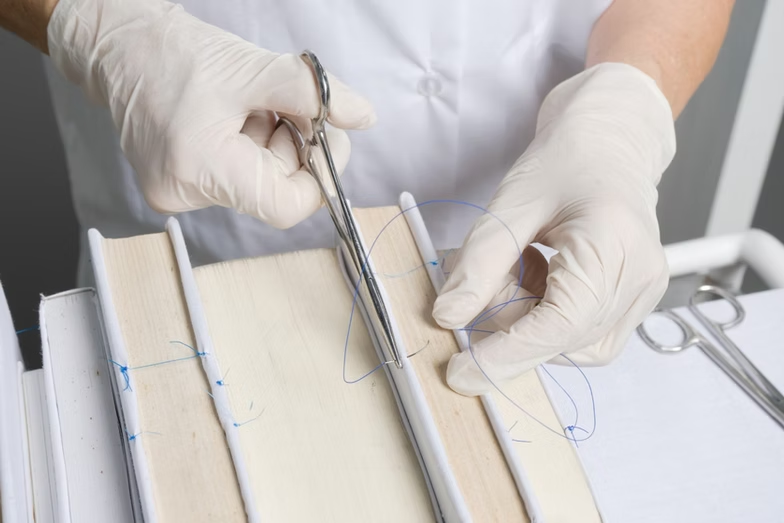
In Libia Posada’s first solo exhibition in the United States, Everything is Going Right, new and existing artworks from the Colombia-based artist and medical doctor emerge within a vernacular and aesthetic of disease and infection, symptoms and treatments. Across installation and sculpture made from medical materials and instruments, the artworks reflect the intersections of medical, social, and political disorders and afflictions that wound both individuals and the collective.
At the center of the exhibition is newly commissioned installation, Blue Portrait, 2026. The artwork was created with women incarcerated in California Institute for Women (CIW) and creates an evocative, and indicting, portrait of the United States prison system, where 1 in 5 women incarcerated in California are over the age of fifty. Other works drawn from Posada’s three-decades-long practice evoke other, overlapping geopolitical contexts of harm. A large map of the world and another of the US are made of layers of medical gauze; a smaller map of Colombia has the poverty line as a conceptual border. Books are sutured shut with careful hand-stitched surgical sutures, closing off other ways of knowing. These are gestures both personal and political, rendering bodily the current conditions in which everything seems to be going wrong and moving right.
Everything is Going Right is organized as part of Visualizing Abolition, an arts-based initiative that reaches across prison borders to contribute to the unfolding collective story and alternative imagining underway to create a future free of prisons.
About the Artist:
Libia Posada is a multidisciplinary artist, trained as a physician and surgeon at the University of Antioquia. Posada’s art is influenced by her medical training, going beyond a fascination with representations of the purely organic or biological to think of the body as a site for the staging of human experience, both individual and collective, and a territory closely connected to the geographical one. In Posada’s artwork, the individual body who passes through clinical spaces—hospitals, asylums—bears the evidence, and the symptoms, of broader social illness: collective, historical, cultural, political.
Libia Posada’s work has been exhibited nationally and internationally.Her solo exhibitions include Definición del Horizonte (Definition of the Horizon), a review of her last twenty years of work, Museum of Modern Art of Medellín; Pasado Tiempo y Futuro: Arte en Colombia siglo XXI (Past, Present and Future: Art in Colombia in the 21st Century); Medellín una historia colombiana (Medellín: A Colombian Story), Musée Les Abattoirs, Toulouse, France; Evidencia Clínica: Retratos (Clinical Evidence: Portraits), National Museum of Colombia (2009) and Museum of Antioquia (2007); as well as her nomination for the Premio Luis Caballero (Luis Caballero Prize, 2011) and Signos Cardinales (Cardinal Signs, 2009).
Group exhibitions include Weather and the Whale, Institute of Arts and Science, UC Santa Cruz; En y entre Geografías (In and Between Geographies), Museum of Modern Art of Medellín; MDE 2015, Museum of Antioquia, Medellín; I Bienal Internacional de Cartagena (I International Biennial of Cartagena, 2014); Face Contact / FOTOESPAÑA, Iberia Center for Contemporary Art, Madrid (2011) and Beijing (2012); Máquinas (Machines), Oí Futuro Media Center, Belo Horizonte, Brazil (2011); Skin, Wellcome Trust, London; MDE 07, Museum of Antioquia, Medellín; Otras Miradas (Other Views), International Itinerant Exhibition, 2004–2006; and the VIII Bienal de La Habana (VIII Havana Biennial), Wifredo Lam Center, Havana, Cuba (2003).
Her work is held in public collections including the National Museum of Colombia (Museo Nacional de Colombia), the Banco de la República Art Collection (Colección de Arte del Banco de la República), the Museum of Antioquia (Museo de Antioquia), and the Gilberto Álzate Avendaño Foundation (Fundación Gilberto Álzate Avendaño), as well as in private collections in Houston, Paris, London, Amsterdam, among others.

