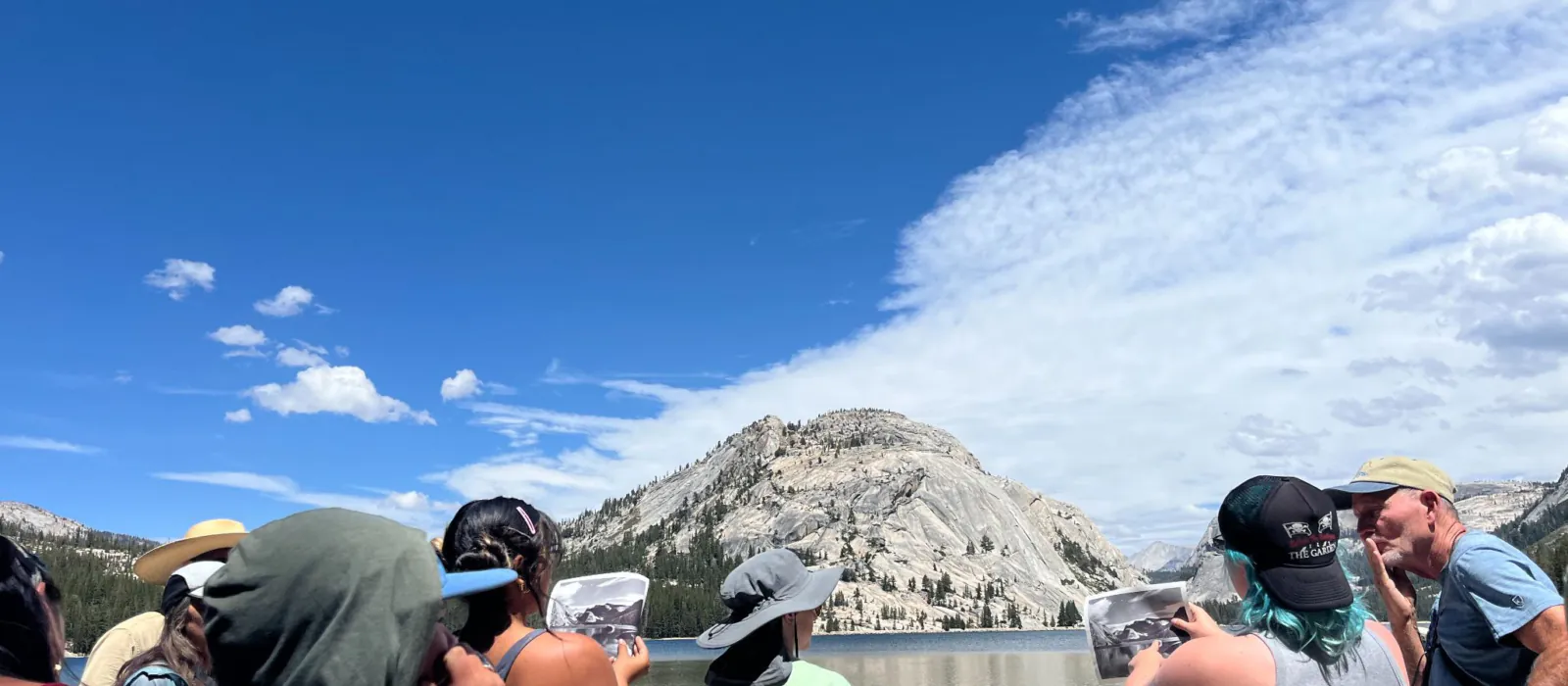
On August 16th, 2026, students enrolled in ENVS 171: Issues in Art and Climate at UCSC packed their camping gear and notebooks and headed to Yosemite National Park for a week of field research. Over the next six days, they visited important sites and heard from National Park Service employees, artists, and members of the seven traditionally associated tribes about conservation, Indigenous land management, and the role of photography in visualizing environmental change.
The trip came on the heels of three weeks of classroom lectures and discussions at the Institute of the Arts and Sciences (IAS), where students learned about the history of Yosemite and the development of tourism, climate science, and conservation programs at the park. As one of the oldest, most mythologized, and most photographed national parks in the US, Yosemite was an instructive case study for critically examining how ideas about wilderness, public land, and nationhood have been constructed since the nineteenth century through science, policy, and images.
“Experiential learning rooted in place is common in the sciences but still relatively rare in the humanities,” explains Rachel Nelson, Director of the IAS and instructor of the course. “The field work was a critical component of the course, extending our inquiries beyond the classroom.”
For the students, who came from different science, social science, and humanities backgrounds, the trip was an opportunity to learn by closely interacting with the site they had been reading about for weeks.
“It was amazing to get out of the sometimes sterile environment of a classroom and experience something tangible from our readings. As a humanities major I don’t often venture too far from my books and desk, so having the ability to experience this way of learning was really eye opening,” says Salem Edwards, a Literature and History student.
Students began the week with a workshop on field journaling and a walk with park ranger Karen Amstutz, who talked about conservation and restoration efforts in Tuolumne Meadows and the various plant and animal species that are indicators of climate change. They also heard from the park’s geologist, Greg Stock, who discussed melting glaciers in the park and their impact on the river and creek system that irrigates its meadows and forests.
Nikolas Stavrianos, a Chemistry student who joined the class with an interest in hydrology, was particularly struck by the presentation. “To hear that we risk losing Yosemite’s glaciers, some of the last in California, within 20 years was a shock,” he says. “Glaciers serve as one of our most sensitive indicators of climate change. Parts of the Sierras are being exposed by melting glaciers for the first time in this epoch. If these glaciers fully melt the impacts will be felt far and wide, so we need to act now.”
On the second day, they traveled to the Mono Lake Basin to meet with Ryan Garrett, the Education Director for the Mono Lake Committee, who talked about the factors leading to the drying up of Mono Lake, which is now experiencing a mega-drought. Later that day, they did a workshop with the artist James Prosek, using drawing as a way to observe and engage more closely with the surrounding landscape.
On the third day, the class travelled to Yosemite Valley and met with Ben Cunningham Summerfield (Mountain Maidu and Turtle Mountain Chippewa), a cultural demonstrator with the Indian Cultural Program, who discussed the impacts of settler colonialism and tourism on the park’s ecosystem and the differences between traditional Indigenous land management and the park’s restoration programs. They also met with Erin “Echo” Davenport, the Archeological Compliance Program Manager at Yosemite, who discussed what cultural artefacts found in the park reveal about the people who lived there thousands of years ago and the different perspectives that inform Western and Indigenous archeology. Students also heard from Nellie Tucker (Southern Sierra Miwuk and Paiute), who shared stories about the Little Fires program, a tribally-driven, multiyear initiative that reintroduces cultural burning to the park.
The week concluded with a climate and photography workshop led by photographers Mark Klett and Byron Wolfe, who discussed the history of photographing Yosemite since the nineteenth century and their own practice of using “re-photography” (a variant of the repeat photography technique used by geologists) to highlight changes in the landscape over time and the choices that go into making images.
The class culminated in a group project, a field guide to Yosemite. Students imagined presenting Yosemite to someone who had never been there before, drawing on the stories they had heard and observations they had made during the trip.
“I was moved by the array of specialists we got to hear from throughout our week,” says Scarlett Cunningham-Young, a Neuroscience student. “While their specialties differed, they were unified by their shared passion and love for Yosemite. It was cool to learn from people who cared so deeply about what they did.”
Starting this fall, some of them will continue working at the IAS as interns, doing preliminary research for an exhibition on Yosemite that is scheduled to open in 2028.
“I look forward to mentoring the students in multidisciplinary curation,” says Alexandra Moore, Curator and Head of Academic Programs at the IAS. “I’m excited to think with them about what a Yosemite exhibition that brings together art and science to draw attention to the impacts of climate change might look like.”