With sculptures of melting popsicles and artworks of people performing rescue carries, new exhibitions at the IAS are a reminder of the potential of art and images to define—and redefine—notions of belonging.
September 14, 2026
New exhibitions are opening on October 2 at UC Santa Cruz’s off-campus art galleries, the Institute of the Arts and Sciences (IAS) located off Delaware at 100 Panetta Avenue: Carlos Motta: When Time Stands Still, and Victor “Marka27” Quiñonez: Ni de Aquí, Ni de Allá (Not From Here, Not From There). Organized for Visualizing Abolition, an art and education initiative, the two exhibitions, each quite different, together are reminders of the importance of art in the current image-saturated and divisive times. In the face of the proliferation of generative AI images and texts that are currently distorting perception, the artworks on view offer a compelling counterargument: look closely, look slowly, look beyond the surface, and perhaps, see what can be hidden by the images—both AI generated and otherwise— shaping the present.
For his second solo exhibition with the IAS, Colombian-born, New York–based artist Carlos Motta’s video of an endurance-based performance, No One, 2024, offers a visceral experience of the tensions that roil the present, when despite all the images that surround us, there is so little true looking. For forty-six long minutes, the artist attempts to keep his eyes open and focused on one spot as a soundtrack combines sounds of drones and other military technologies with words banned for use in documents by the US federal government. The performance, an extreme act of witnessing, evokes the unsettling experience of trying to process the present deluge of visual information; even events and violences that are widely visible, splayed across social media and other outlets, can be denied.
“The speed in which information is transmitted in the present—including the trafficking in images of violence—demands us to slow down, pay attention, and respond with acts of sustained attention and care,” Motta says.
Motta, whose internationally-acclaimed work has most recently been featured in a mid-career survey at the Museu d’Art Contemporani de Barcelona (MACBA) and OK Center for Contemporary Art, Austria, connects art history to this dilemma. The Ship of Fools, 2026, an artwork created for the exhibition, is a sculptural installation obliquely referencing past works bearing similar names: an early Netherlandish painting by Hieronymus Bosch from 1490–1500; woodcuts attributed to the German painter and printmaker Albrecht Dürer from the 1490s. Despite the hundreds of years between those works and Motta’s three-dimensional reinterpretation, the critique of politics in the latter’s references—and the portrayals of the vices and corruption rife in governance that Bosch and Dürer were making—seems effortlessly contemporary. The reappearance of these “fools,” now ornate ceramic sculptures, is a reminder of what happens when we do not look and learn from the past.
The sculptures of The Ship of Fools sit on a large raised platform designed also for use as a stage. A performance series curated by Motta and Rachel Nelson, IAS director, has been organized to provide other opportunities to allow people to slow down and reflect on the issues of time and representation, featuring renowned artists Regina José Galindo, Okwui Okpokwasili, Samita Sinha, and Alexandra Tatarsky, each of whom will contribute works that promise to resonate with the demands for careful attention implicit in When Time Stands Still. Sinha, who also collaborated with Motta on Song to the Siren, 2026, on view in the exhibition, will launch the series on October 2, 5–8 p.m. (Further details forthcoming.)
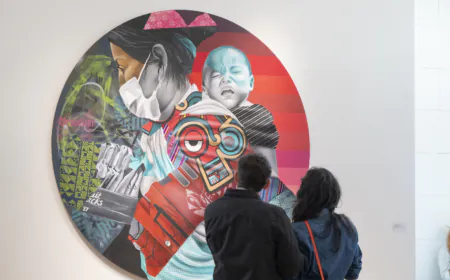
The brightly colored paintings and installations of multidisciplinary artist Victor “Marka27” Quiñonez’s Ni de Aquí, Ni de Allá (Not From Here, Not From There) plunge viewers into another kind of looking. The exhibition, including an altar made from an ice cooler, an elaborately immersive botánica (a store for religious goods and spiritual healing), and paintings referencing the visual symbolism of graffiti compels people to see what surrounds them, through details often ignored. A jumbo red resin sculpture in the shape of melting Mexican paletas (popsicles) from a series called I.C.E. Scream is more than a critique of current US immigration policies (the popsicle stick is marked “U.S. Inhumane and Cruelty Enforcement—an obvious play on US Immigration and Customs Enforcement). The melting ice pop is also a reminder that for centuries the US was referred to as a “melting pot,” describing what was imagined as a fusion of cultures that composes the nation. Quiñonez brings into sight what is more aptly described as the lively “multiculturalism,” the coexistence of multiple cultures, that still defines the country, despite the prevalence of nationalistic visions of belonging and anti-immigrant rhetoric.
The IAS will be the second venue to successfully present Ni de Aquí, Ni de Allá to the public. First organized by Boston University Art Galleries in September 2025, the exhibition debuted to critical acclaim before gaining national attention after its abrupt removal from its second venue, the University of North Texas, where it had been installed just one week prior to it being censored. In its current iteration at the IAS, one might imagine that the censorship was because the exhibition, with its celebration of cultures and communities, is so directly opposed to the rise of “deep fakes” and other image productions that fuel contemporary politics.
Ultimately, instead of xenophobia and distrust, the exhibitions on view at the IAS offer proposals for more expansive ideas of belonging. This is a message intended to reach audiences beyond the university gallery. Also organized by the IAS, Quiñonez’s Elevar la Cultura, an immersive sculptural installation featuring a twenty-two-foot-tall pyramid built from ice coolers adorned with ancestral textiles, sacred symbols, and mural work, will be on view at Santa Cruz Barrios Unidos (SCBU, 1817 Soquel) November 7, 2026–March 7, 2027. As Quiñonez explains, this sculpture epitomizes the contradictions of living—and laboring—as an immigrant in the United States:
“Most people see the cooler as a tool for leisure … for barbecues, tailgating, and celebrations. But for immigrant communities, the cooler is a tool and symbol for opportunity and independence. In every major city, you see families and vendors selling fruit, food, and water out of these coolers on the streets…. They’re a necessity for survival and a way to start an honest living,” the artist shares.
On view at SCBU, an organization founded through the principles of the Chicano civil rights movement and antiwar activism, the sculpture will act as a beacon to communities and a signal of belonging.
Carlos Motta: When Time Stands Still, and Victor “Marka27” Quiñonez: Ni de Aquí, Ni de Allá (Not From Here, Not From There) will be on view at the IAS from October 2, 2026, to March 7, 2027.